

Click here for SHIGO POINTS on CRACKS
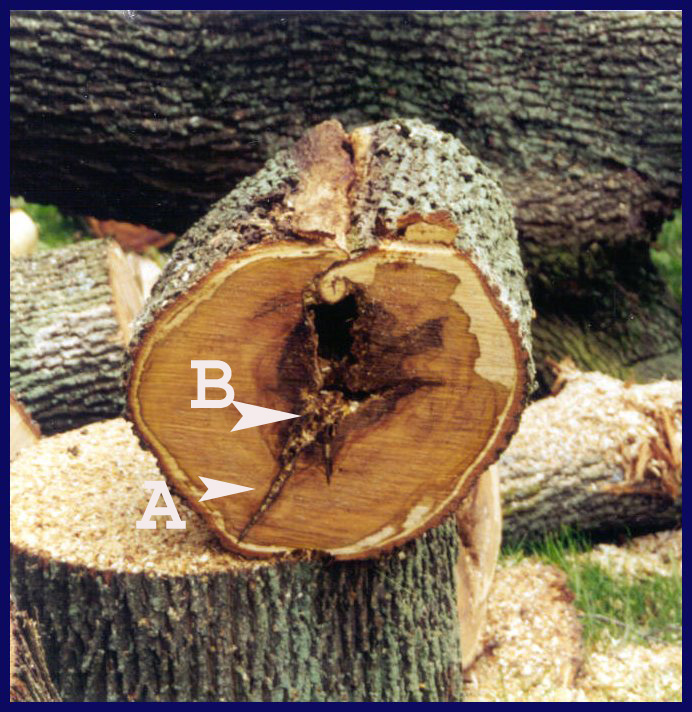
The crack at point A is extended from wounds at point B. So the primary agent is the old wound as the starting point of the crack.
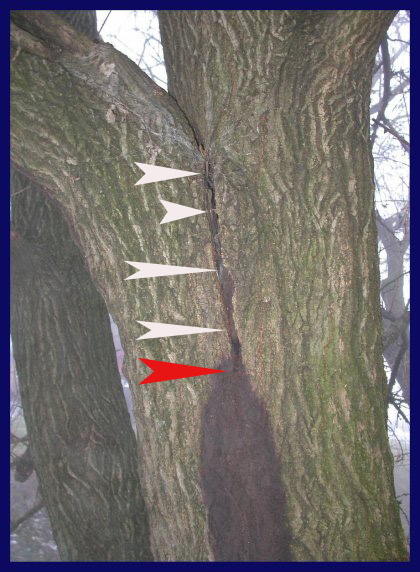
The white points are the crack which is a result of included bark. The red pointer is where wetwood fluids are exiting. Wetwood is a Protection Wood. Here cables will be installed following some selective pruning to extend the safe period. We will not drain wetwood because it is a protection feature for the tree.
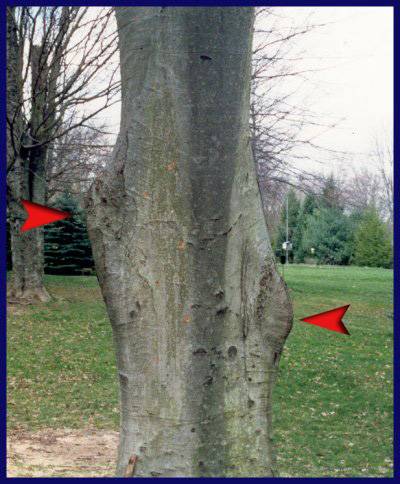
Trees have a language. We call it the body language of trees. You learn to see the signs. Here we have what we call Pinocchio Noses. They are a sign that this tree may be moving into a high risk of hazard category. Next picture will be a transverse view of this tree.
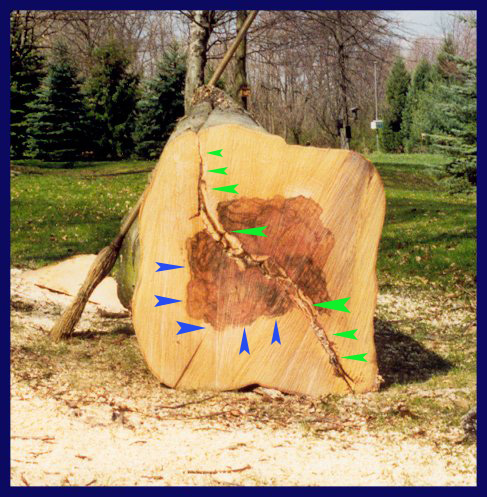
The Green Pointers is a primary crack. The blue points to color altered wood from a wound or an injury. That is not heartwood and this tree, beech, is not a heartwood forming tree.
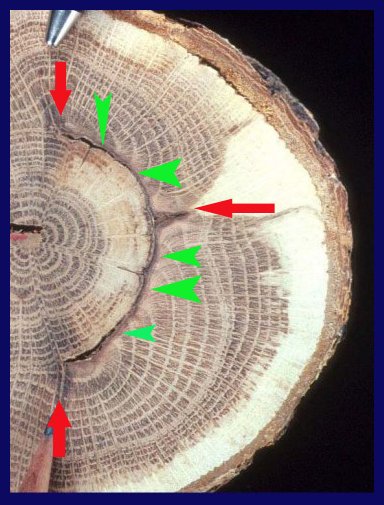
The green points to the barrier zone. The barrier zone
represents the size of the tree when it had a serious wound. The Red
Arrows are 3 cracks that are starting from the old wound. Microorganisms
are following the crack so you are starting to see the changes in color as a
result. Remember, the crack comes first then the microorganisms follow.
One point is that the cracks are not starting from sun or frost. The
starting points are old wounds.
Image Source - TREES, ASSOCIATES, and SHIGO (2 CD
set).

Same theme here again. Over and over and over.
Image Source - TREES, ASSOCIATES, and SHIGO (2 CD set).
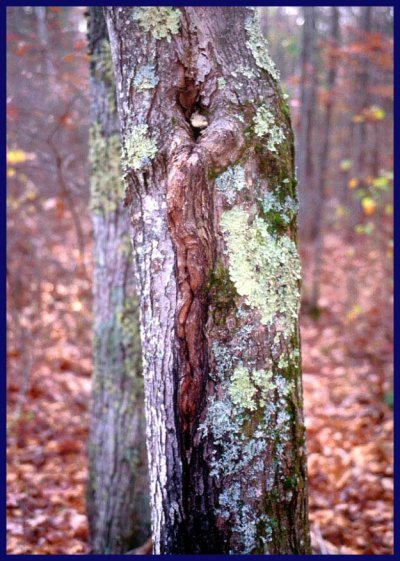
Here is a crack below an old branch stub.
Image Source - TREES, ASSOCIATES, and SHIGO (2 CD set).

This is not a crack starting from the inside out, this is at the base of a fissure as the tree is growing in girth.
Image Source - TREES, ASSOCIATES, and SHIGO (2 CD set).

Dictionary MAIN
PAGE
Text & Graphics Copyright © 2009
Keslick & Son Modern Arboriculture
Please report web site problems, comments and words of interest,
not found.
Contact